Looking for the latest information on Module 11 Assignment Question 23? We've researched comprehensive data, records, and insights about Module 11 Assignment Question 23.
Main Features
Explore the key sources for Module 11 Assignment Question 23.
Recent Updates
Stay updated on Module 11 Assignment Question 23's newest achievements.
Nishta 3.0 module11 answers in English | TS-F11- Integrating ICT in Teaching,Learning and Assessment
Module 11 Assignment Question 26
Module 11 Assignment Question 18
Module 11 Assignment Question 19
Module 11 Assignment Question 20
Module 11 Assignment Question 17
Module 11 Assignment Question 10
Module 11 Assignment Question 12
Module 11 Assignment Question 5
Module 11 Assignment Question 11
Module 11 Assignment Question 16
Deep Dive
Data is compiled from public records and verified media reports.
Last Updated: October 16, 2026
Future Outlook
For 2026, Module 11 Assignment Question 23 remains one of the most talked-about information profiles. Check back for the newest reports.
Disclaimer: Disclaimer: All information is compiled from publicly available data, media reports, and analysis. Actual details may vary.
Summary
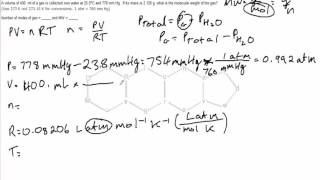
... molecular weight we know what we're after, molecular weight is always grams per mol, now in the So here is a gas stoichiometry type ... so now we're in the position to solve our Dr. Richard Musgrave demonstrates how to calculate the molecular weight of a gas sample. Using the ideal gas law, PV=nRT, the process involves converting provided measurements into units compatible with the ideal gas constant to solve for the unknown molar mass. What I want you to see here is we've got a P1*V1 over T1 equals P2*V2 over T2 I'd to show you an example now of a molecular weight type of Okay so we're looking at a molecular weight